Citizens and constituents increasingly expect their governments to match the level of customer service they receive from the private sector. According to research from Nortal, 70% of Canadians want fully digital public services and 87% expect that to happen this year. While it may sound like a contradiction, “customer communications in the public sector” has become a real practice for professionals as governments attempt to “sell” programs and “design” optimal service delivery experiences.
Public sector customer communications mainly refers to communications from the service arm (civil service) of the government. For example, in Canada, Service Canada’s communications could be classified as customer communications in the public sector.
Public sector customer communications is about connecting with millions of customers, constituents, or citizens. It relies primarily on Uses and Gratifications Theory and the Two-Step/Multi-Step Flow Theory and helps an audience become aware of the services available to it, how to access those services, and how to use them. Clear, timely, and accurate public sector customer communication plays an important role in maintaining public trust.
Effective customer communications in the public sector does not take an ad hoc approach. Instead, it is structured, intentional, and anchored in:
- organizational goals as outlined by mandates that have been approved by an electorate or a Board of Directors;
- research that delivers an objective understanding of an audience’s needs, attitudes, and opinions, and;
- measurement of the effectiveness of different communications programs
Understanding goals and mandates of a government
How do you ensure that your communications are aligned to and anchored in the goals and mandates of the government or the department you’re representing?
You can look at each department’s mandate or strategic plan. You can find documents like this whether you’re doing communications for the federal government (see: Departmental Plan 2025-26 — Canadian Heritage) or for a local government-affiliated body (see: 2024-2028 TTC Corporate Plan – Moving Toronto, Connecting Communities).
Questions and activities for your team at this stage:
Question: What is our guiding document, mandate, or goal?
Activity: Find that document and make sure that everyone is familiar with it.
Gathering Data on Your Audience’s Needs, Attitudes, and Opinions
There are a number of methods that the Government of Canada uses to gather data. Gathering objective data is an important part of delivering evidence-based customer communications in the public sector. Potential sources include:
- Public Opinion Research (POR) gathered through phone and email surveys and focus groups organized by the Government of Canada
- Social media monitoring
- Complaints and feedback about Service Canada tracked through the Office for Client Satisfaction
There are also national public opinion polling agencies, such as the Angus Reid Institute, Ipsos, and Nanos, which gather this data.
You can find guidance on how the government manages public opinion research in Appendix B: Mandatory Procedures for Public Opinion Research in the Directive on the Management of Communications and Federal Identity.
How do you design a survey?
- Decide what you want to learn
- Tailor your language and questions to your audience
- Keep it short – about 5 to 10 questions
- Avoid jargon
- Don’t lead the respondents
- Ask one thing at a time aka avoid double barrelling
- Vary question types (rank from 1 to 10, multiple choice, open ended)
- Put easy questions first
- Explain the purpose and time needed
- Customize
- Test it with a few people to catch any errors
- Collect the data
- Analyze the data
- Report on the data
Some of the key quality questions you’ll have to answer are:
- What was the sample size and the reach of your survey?
- What is the margin of sampling error?
- How were the interviews conducted and when did this fieldwork occur?
- Were the questions neutral or leading?
- How were open-ended questions coded or analyzed?
- Who funded the research?
- What was the purpose of the research?
What are the top tools for analyzing public opinion?
- Brandwatch
- Crimson Hexagon
- Hootsuite
- CisionOne
- Brandwatch
- Talkwater
- Meltwater
- Brand24
Questions and activities for your team at this stage:
Question: What kind of data or data gathering tools do we have at our disposal?
Activity: Make a list of the type of data you have access to and the database or tool that it’s hosted in.
What are the key components of a public sector communications strategy?
An effective public sector communications strategy includes the following:
- Component 1: Articulation of clear goals and objectives
- Component 2: Segmentation of your target audience
- Component 3: Formulation of narrative and key messages
- Component 4: Selection of the appropriate channels
- Component 5: Creation of the budget and the implementation timeline
- Component 6: Identification of KPIs and evaluation tools to measure them
Component 1: How do you articulate clear goals and objectives for your public sector communications?
A goal is something broad that you want to achieve while an objective is a clearly defined result.
You also have two levels of goals and objectives: your organizational-level goals and objectives and your communication strategy-level goals and objectives.
Organization-Level Goals and Objectives
Whenever you’re communicating something, ask yourself: how is this supporting one of our overarching goals?
For instance, if you were managing communications for Employment and Social Development Canada (ESDC), a department within the Government of Canada, you could look at “Employment and Social Development Canada’s 2025 to 2026 Departmental plan: At a glance”, which highlights 8 key priorities:
- support the Government’s commitment to make housing more affordable by creating new careers in the skilled trades. We’ll do this by helping workers gain the skills needed for jobs in residential construction to build both traditional and modular housing, through initiatives such as the Sustainable Jobs Training Fund, the Sectoral Workforce Solutions Program and the Canadian Apprenticeship Strategy
- contribute to the Government’s efforts to attract the best talent in the world to help build our economy, while returning our overall immigration rates to sustainable levels. We will support this by ensuring that only genuine employers with real labour market needs can access the Temporary Foreign Worker Program
- keep working with our partners to build and maintain a Canada-wide early learning and child care system
- continue our work to implement the National School Food Program in collaboration with provinces, territories, and Indigenous partners
- continue to help seniors afford retirement through the delivery of the Old Age Security (OAS) program and the Canada Pension Plan (CPP)
- expand the Foreign Credential Recognition Program to start at least 5 projects in the residential construction and health care sectors. This will help people trained abroad join the Canadian workforce to build more homes and meet the demand for health care workers
- make amendments to the Employment Insurance Act to add a new 15-week adoption benefit that parents can share
- onboarding eligible Canadian adults, aged 18 to 64, to the Canadian Dental Care Plan (CDCP) and introducing a renewal process for existing clients, with support from Health Canada
Each time you come up with a specific communication activity, you can ensure that it’s relevant by linking it back to a specific organization-level goal or objective.
Communication Strategy-Level Goals and Objectives
After this, it’s important to know what your communication strategy level goals and objectives are. In customer communications for the public sector, most activities can be linked to one of these general goals:
- Spread awareness of a program, service, or new piece of information (Attention)
- Support your audience in their decision-making process with factual, relevant information (Trust)
- Encourage positive behaviour change (Action)
Examples of objectives for each of these goals are:
- An objective for the Attention section might be: “Increase organic web traffic by 25% by Q2 by creating more high-quality content that answers questions our audience is searching for ”
- An objective for the Trust section might be: “Increase the number of marketing qualified leads by 10% by creating a high quality, gated lead magnet.”
- An objective for the Action stage might be: “Increase the number of demos by 30% by Q4 including an interactive self-guided product tour on the website.”
Questions and activities for your team at this stage:
Question: Decide on whether your goal is to generate attention, build trust, or inspire action.
Activity: Develop an objective that’s aligned with one of these communication goals.
Component 2: How do you segment your target audience for public sector communications?
Let’s say that you want to generate awareness of what the government is doing in relation to one of the above priorities. Let’s pick the following priority:
- keep working with our partners to build and maintain a Canada-wide early learning and child care system
If the communication goal was to generate attention and spread awareness, the communication plan would focus on:
- The government’s latest activities around this goal such as what’s happening with the Early Learning and Child Care Agreements
- How the government is spending the 2021 investment of over $27 billion over five years
- Upcoming votes related to Supply Bills for releasing that year’s funds
If the communication goal was to build trust, the communication plan would focus on:
- Their partners (such as the governments of other provinces) and how they are working together to execute on this plan
- Demonstrating the results of their funding such as the number of daycare centres opened or the number of children served
- Reporting on meetings of leaders from across the country and from different provincial and territorial governments
If the communication goal was to inspire action, the communication plan would focus on:
- The need for participation in consultations from parents, early childhood education members, and community members
- The need for partnership and cooperation from ministers and other leaders from different provinces
The next step would be to gather data on which stakeholders care most about these initiatives. That would be:
- Parents
- Child care providers (public and private operators)
- Experts (academics, policy analysts, think tanks, non-profits, advocacy groups)
- Indigenous peoples
- Official language minority communities
Component 3: How do you formulate your narrative and key messages?
When crafting key messages, it’s important that they’re concise (1 to 3 sentences or under 30 seconds), aligned to organizational goals, and memorable (there are creative writing techniques for making content memorable such as using assonance, consonance, and alliteration). They should also be credible, meaning that they’re backed up by evidence, statistics, or a trusted authority. They should also be consistent, meaning that they’re repeated in the same way across multiple channels. They should also be clear, meaning they don’t use technical language.
In short, key messages should be clear, concise, credible, and consistent.
These Early Learning and Child Care Agreements support the Government of Canada’s Toward $10-a-Day Initiative. You can spot a few key messages on their webpage:
- All families in Canada should have access to high-quality, affordable, flexible and inclusive early learning and child care no matter where they live.
One way to organize key messages is through themes. The key themes of this initiative are:
- Affordability
- Savings
- Working together
- Benefits
- Data and information
Let’s look at the key messages that support each of these themes.
Theme 1: Affordability
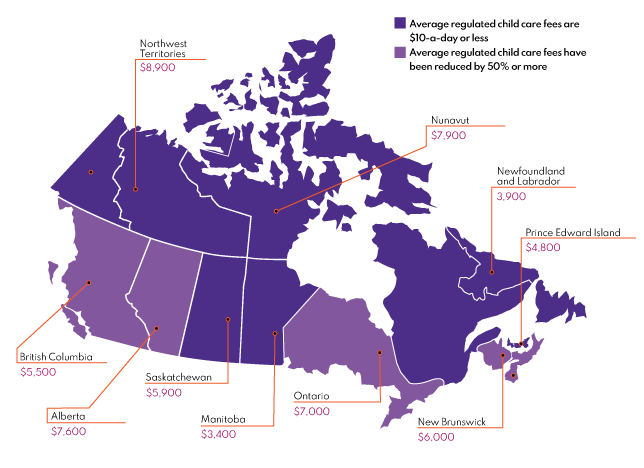
Key Message 1: To make childcare more affordable we reduce fees by 50% on average by the end of 2022 and are working towards bringing fees down to $10-a-day on average.
Audience: Parents, advocacy groups
Key Message 2: We are working with provinces and territories to make meaningful progress towards a Canada-wide Early Learning and Childcare system that works for families. Our targets are applicable everywhere outside of Quebec where an affordable, well-established early learning and child care system already exists.
Audience: Experts (academics, policy analysts)
Theme 2: Savings
Key Message 3: Fee reductions and estimated average annual savings for regulated/licensed child care per child, since the introduction of the Canada-wide system
Audience: Experts
Theme 3: Working together
Key Message 4: Between July 2021 and March 2022, we reached Canada-wide early learning and child care agreements with all 13 provinces and territories, including an asymmetrical agreement with the Government of Quebec.
Audience: Experts, parents
Key Message 5: Since then, the Government of Canada signed five-year extension agreements (from fiscal year 2026 to 2027 to fiscal year 2030 to 2031) with 11 provinces and territories, ensuring predictable federal support for early learning. Additionally, Ontario and Alberta signed one-year extensions to the Canada-wide agreements (from fiscal year 2026 to 2027).
Audience: Experts, parents
Key Message 6: We are working directly with First Nations, Inuit and Métis partners to advance the shared vision that all Indigenous children should have the opportunity to experience high-quality, culturally strong early learning and child care. We have strengthened relationships with over 65 Indigenous partners to advance the goals of the Indigenous Early Learning and Child Care Framework as part of the Canada-wide early learning and child care system.
Audience: Indigenous peoples
Key Message 7: Inclusion will make sure every child, including children with disabilities, Indigenous children, and official language minorities, has access to affordable, high quality child care.
Audience: All audiences
Theme 4: Benefits
Key Message 8: High-quality, affordable, flexible and inclusive early learning and child care is important for the future of children. Access to child care also promotes greater gender equality by allowing more parents, particularly mothers, to participate in the workforce and achieve greater economic security. It also improves and grows the female-dominated early childhood educator workforce.
Audience: Experts
Theme 5: Data and information
Key Message 9: As part of accountability to Canadians, sharing progress of the early learning and child care system is essential. Publicly available data on economic results such as labour force participation rate, Consumer Price Index of child care services and key metrics such as affordability, space creation and the ELCC workforce results will help us measure progress of the early learning and child care system, and identify areas for improvement and inform future policy decisions. For more information, visit Progress and impact of Canada-wide Early Learning and Child Care.
Audience: Parents, experts
Component 4: How do you select the appropriate channels?
Some of our channels would be:
- The Globe and Mail
- The Canadian Press
- The National
- Newspapers
- Radio shows
- TV news shows
- X
- TikTok
Digital communications in the public sector
Digital communications activities in the public sector often have directives to support them. For instance, the Government of Canada has the Directive on the Management of Communications and Federal Identity. Digital communications for public sector customer communications uses tools such as social media (X, Facebook, YouTube), websites, newsletters through platforms like Mailchimp, and digital content distributed through videos and blogs. This allows governments to engage in “write once, read everywhere” activities.
Email communications in the public sector
Email communication is often used in the public sector for distributing information on emergency alerts, municipal updates, taxes, and public health. A subscriber-led model, where citizens and constituents opt into specific topics they want updates about, is recommended. For instance, interested parties can opt into receiving updates from the Secretary of State (Seniors) or about the Labour Program. You can also sign up to receive updates about funding opportunities from Employment and Social Development Canada (ESDC).
Social media communications in the public sector
Social media communications in the public sector is focused on creating conversations and two-way engagement. It also plays an important role in helping governments monitor public sentiment and manage any crises. The rules for this are outlined in Appendix C: Standard on Managing Official Social Media Accounts of the Directive on the Management of Communications and Federal Identity.
Advertising as part of customer communications in the public sector
The government publishes extensive guidelines on its approach to advertising from the Government of Canada.
Multi-channel citizen communications in the public sector
Multi-channel citizen communications involves using a mix of traditional and digital channels to meet citizens and constituents where they are, building trust and accessibility in the process.
Component 5: How do you create the budget and implementation timeline?
For the budget, you’ll need to determine the cost of:
- Personnel and Contractors: This includes freelance writers, freelance designers, and agency fees.
- Technology and Tools: Software for media monitoring, social media management, and email marketing.
- Media & Advertising: Paid social ads, print, or local media advertisements
- Content & Assets: Production costs for videos, reporting, and photography
- Events: Sponsorships or costs for virtual/in-person conferences
There are also a number of different integrated marketing communications (IMC) budgeting methods that you can use, including:
- The Objective-and-Task Budgeting Method
- Advantage: Ensures strategic alignment and flexibility
- Disadvantage: Requires more time and effort than a top down method and it can be difficult to determine how much time and effort each task needs
- The Percentage of Revenue Method
- Advantage: Simple to create and ensures there’s no overspending.
- Disadvantage: Can lead to underspending in key areas
- The Competitive Parity Method
- Advantage: It prevents dangerous underspending.
- Disadvantage: Assumes competitors have similar goals and knowledge, leading to missed unique opportunities
For drafting your implementation timeline, you would:
- Define phases and milestones such as “send out press release” or “research” or “website live”
- List all tasks such as drafting emails, scheduling social media posts, or designing graphics
- Assign responsibility to make it clear who owns each task
- Sequence and schedule outgoing communications
- Determine how frequently messages are sent out
- Schedule time for reviews and approvals
- Map everything to a shared calendar that everyone can see
Component 6: How do you identify KPIs and the evaluation tools to measure them?
Some KPIs include:
- Message penetration rate
- Sentiment score by theme
- Share of Voice
- Keyword association frequency
- Content engagement rate by theme
- Conversion rate on thematic assets
How do you measure message penetration rate?
Message penetration rate is measured using a mix of quantitative metrics (impressions, share of voice) and qualitative analysis (surveys and sentiment analysis). Key methods for tracking this include tracking media coverage, calculating aided and unaided recall through surveys, and using analytics.
How do you measure sentiment score by theme?
What is a sentiment score?
A sentiment score is a numerical value that’s assigned to words based on their emotional weight.
Is there a proven framework for sentiment score calculation?
There are lexicon-based frameworks, machine learning-based frameworks, and deep learning and transformer frameworks.
Lexicon-Based Frameworks
- VADER (Valence Aware Dictionary and sEntiment Reasoner)
- SentiWordNet
- SO-Cal (Semantic Orientation Calculator)
Best for: social media
Machine Learning-Based Frameworks
- Supervised Learning
- Hybrid Approach (ML+Lexicon)
Best for: structured datasets
Deep Learning and Transformer Frameworks
- BERT (Bidirectional Encoder Representation from Transformers)
- LSTM (Long Short-Term Memory)
Best for: High accuracy, context-heavy text
How do you assign scores by theme?
This involves using Natural Language Processing (NLP) to segment text data into topics such as service or quality and then applying sentiment classifications (positive, negative, neutral) to each segment.
Some tools that you can use include:
- Social listening and media monitoring tools
- Intranet/Website Analytics
- Pulse surveys and pulse polls
- Content analysis
- Focus groups and interviews
It’s also important to set a baseline by measuring these metrics related to your theme before you launch your campaign.
Measuring the effectiveness of different communications programs
There are different tools and approaches you can use based on the outcome you’re trying to measure. There are three main categories:
- Engagement (Attention)
- Sentiment (Trust)
- Action (Action)
Tools to use when you’re measuring engagement
The first is email. Your email marketing tool can give you insight into open rates and click through rates. The second is your web analytics or intranet analytics that can tell you the number of page views and unique visitors. You can also use heatmaps to see where visitors spend the most time on each page. There are also social media analytics that can tell you how far your content reaches and how people engage. Finally, if you’re using a video publishing tool that includes analytics, you can see how many people have watched your videos, how long they spent watching them, and where they tended to fall off.
Tools to use when you’re measuring sentiment
If you’re trying to gauge people’s sentiment about your message, there are a number of tools that you can use. The first is pulse surveys. These are quick surveys that are only a few questions long and that can tell you how people feel about programs or initiatives while they’re in progress. Another option is to create feedback loops by opening comments sections or giving people an opportunity to send their opinions to an email address. If you’re more focused on measuring understanding, quick comprehension quizzes can tell you whether the message is getting through.
Tools to use when you’re measuring action
Finally, you want to know whether your public sector customer communications are leading to tangible action and behaviour changes. A few ways you can do this is by tracking adoption rates (such as adoption of an app or sign ups for an event), measuring how many people have signed up for a particular benefit, looking at turnover and retention rates, conducting time-to-task testing which measures how much quickly users are able to complete a task like finding information on the company’s intranet or website.
Customer communications in the public sector is purposeful, evidence-based, and audience-focused
Customer communications in the public sector does not take a one-size-fits-all approach. It focuses on enhancing the goals of the organization (purposeful), using data and tangible insights to make decisions (evidence-based), and takes the needs of the people receiving the message seriously (audience-focused).


You must be logged in to post a comment.